
[By design, DSPA was created to advocate for Commercial Drone Service Providers in the U.S. But sometimes something else pops up where we feel the need to stray outside that charter. This is one such instance.]
For years, the federal government has been mandating that agencies and public safety organizations stop using Chinese-manufactured drones and started pushing them towards approved “Blue UAS” platforms. The argument has largely centered around cybersecurity, supply-chain security, and national security. Three very important criteria. But at what cost to agencies and persons those agencies are tasked to keep safe?
A newly released, 47 page Department of Homeland Security report, raises a much more practical question those of us in the drone industry have been asking for years: Can the drones the government requires many first responders to buy actually do the job?
Download the full report here!
According to DHS’s own testing, the answer is much more complicated than a simple “Yes or No”. Download and read the above report. And then ask yourself if you feel our government is headed in the right direction when it comes to how drones are actually used in protecting U.S. citizens and First Responders.
_______________________________________________________
The Department of Homeland Security’s Science and Technology Directorate, through its National Urban Security Technology Laboratory (NUSTL), put six Blue UAS platforms into the hands of experienced public safety drone pilots and tested them in rural, urban, and complex urban environments. Twenty-six experienced Remote Pilots participated in three assessments conducted between June 2024 and July 2025. Testing took place in rural Texas, urban Miami, and the dense urban environment of Hudson Yards in New York City.
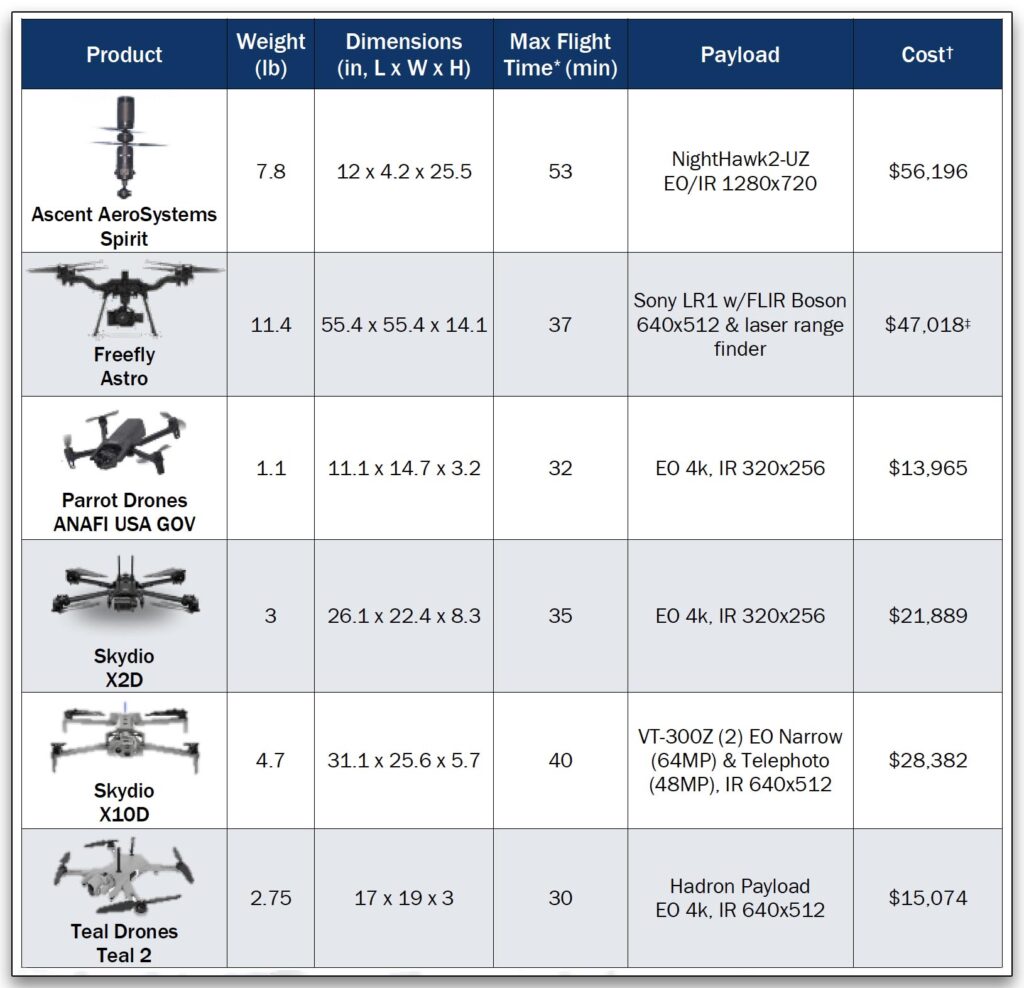
The six Blue UAS tested below ranged from roughly $14,000 to more than $56,000 and included the Ascent AeroSystems Spirit, Freefly Astro, Parrot ANAFI USA GOV, Skydio X2D, Skydio X10D, and Teal 2.
_______________________________________________________
This is where the report gets interesting.
A Blue UAS designation primarily tells an agency that a drone meets certain federal sourcing and cybersecurity requirements. What the Blue UAS designation does not do is tell a fire chief, police department, emergency manager, or Remote Pilot whether that aircraft is capable of accomplishing the mission they need it to accomplish. DHS makes that distinction very clear. This assessment wasn’t designed to determine whether the aircraft posed a national security risk. It was designed to evaluate their operational performance for first responders. Yet not all of the results of those tests are included in this report. More on that in a bit.
That distinction matters. A police department shouldn’t be forced to buy a drone just because it looks good on an approved government list. They should be allowed to buy the tool that will be expected to provide the best overwatch during an active incident. Or a fire department may need it to look at a roof during a structure fire. Or a search and rescue crews may use it to find a missing person. Emergency managers demand immediate situational awareness after a disaster. And rightly so.
In those situations, reliability isn’t optional.
Perhaps the most significant finding in the assessment is summed up in one very simple sentence from DHS: “GPS cannot be relied upon for positioning in dense urban environments.”
Think about what that means operationally. A First Responder Remote Pilot flying between buildings during an emergency may already be flying the aircraft, operating the camera, maintaining situational awareness, and communicating information to an incident commander. If the aircraft can’t reliably maintain its position, the pilot now has to devote additional attention simply to keeping the drone where it’s supposed to be. Aren’t their jobs difficult enough already? Why does the Federal Government feel the need to make it even more difficult?
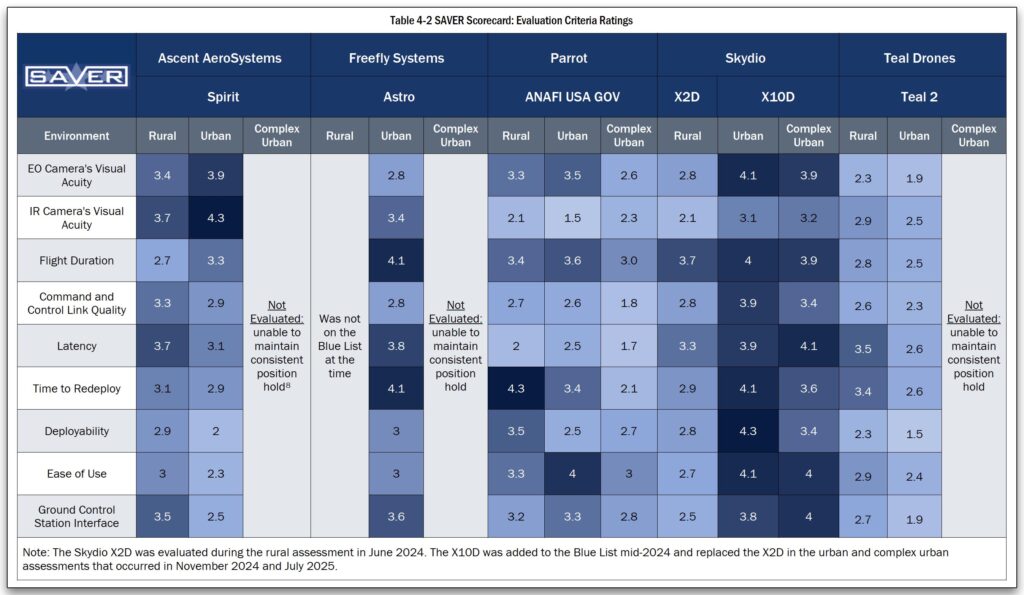
This wasn’t theoretical. Three of the six aircraft, the Ascent AeroSystems Spirit, Freefly Astro, and Teal 2, could not be fully evaluated in the complex urban environment because they could not reliably maintain position hold. DHS identified factors including RF interference, obstruction of the GNSS sky view by buildings, and GNSS.
Those aren’t unusual circumstances for First Responders. They’re exactly the conditions they should expect when operating in major metropolitan areas.
Command-and-control reliability was another major concern. DHS reported Blue UAS disconnects occurring, “as close as 50 feet from the launch point in some instances”.
Not 500 feet. Not half a mile. FIFTY FEET!
The Parrot ANAFI USA GOV experienced particularly significant difficulties during complex urban testing. Operators encountered connectivity problems at distances as short as 50 feet, insufficient GPS/satellite connections, signal warnings, radio resets, loss of link, and an inability to launch between high-rise buildings. The assessment even documents a flyaway.
Even the Skydio X10D, which performed much better in the assessment overall, wasn’t immune. Evaluators experienced connection loss at short distances while operating between high-rise buildings.
For a recreational pilot, a connection problem is usually just frustrating. For a firefighter, police officer, or search and rescue team trying to gather critical information during an emergency, it can mean the aircraft simply can’t accomplish the mission. And this can literally mean the life or death of a missing person or First Responder. And why is that fact rarely part of the discussion in D.C.?
_______________________________________________________
What about deployment time?
DHS didn’t mince words: “Deployment time was unacceptable for most first responders.“
Evaluators encountered ground control station disconnections, pairing problems, system resets, GPS lock failures, Remote ID failures, and calibration delays. The Teal 2 experienced pairing problems that delayed deployment by up to 15 minutes in some cases. Other platforms also experienced multi-minute startup, pairing, or calibration delays.
Fifteen minutes can be an eternity during an emergency. If an officer needs immediate overwatch, a firefighter needs to know what’s happening on a roof, or a search team believes they’ve located a missing person, every minute matters.
_______________________________________________________
And then, of course, there is the elephant in the room: cost.
DHS calls the cost of Blue UAS a “significant barrier for many departments.” And a “significant barrier” can easily be the deciding factor for the many smaller and rural departments that don’t have the tax base or budget expansions available to many larger First Responder agencies. Again, another life or death consequence of legislation and regulation based on hard money lobbying and political posturing.
The DHS tested configurations ranged from approximately $13,964 to $56,195. The issue isn’t simply whether a department can find enough money to purchase one expensive drone. A department working with a fixed budget may have to choose between purchasing multiple aircraft distributed among stations, teams, or vehicles, or purchasing a much smaller number of expensive (& apparently less effective) systems.
DHS itself recognized that excessive costs could result in fewer unmanned platforms and potentially divert funding from other critical equipment. DHS EVEN CALLED THIS OUT!
It’s also important to be fair about what this report says. This isn’t evidence that every Blue UAS is always incapable of public safety operations. Some performed considerably better than others. The Skydio X10D, for example, received higher marks for ease of deployment, autonomous navigation, and its NightSense capability. Although even the X10 encountered connectivity, latency, and other operational issues.
So the takeaway shouldn’t be that Blue UAS don’t work. The takeaway is that a cybersecurity or procurement designation is not a substitute for operational capability!
_______________________________________________________
And this is where the report gets even more interesting.
DHS didn’t test only Blue UAS. They also tested drones manufactured in “covered nations” (read DJI & Autel).
That’s an incredibly important detail given the ongoing debate surrounding Chinese-manufactured drones and their use by American public safety agencies. DHS acknowledges that public safety agencies continue using covered-nation UAS because of their “reliability and overall performance.” Those aircraft were tested alongside the Blue UAS during the complex urban assessment. But how did they fare?
According to the report’s Executive Summary, evaluators identified “significant differences in the capabilities between UAS from covered nations … and the select Blue UAS.“
So what were those significant differences? We don’t know. DHS withheld those comparative results from the general public. Instead, the report states: “Results related to the covered nation platforms is available to public safety agencies upon request.”
That may be one of the most important sentences in the entire report.
DHS conducted the comparison. DHS has the data. DHS acknowledges that testing revealed significant capability differences between the covered-nation aircraft and the Blue UAS. But those results aren’t included in the publicly released report.
Apparently, public safety agencies can request them. The rest of us are left wondering what DHS found. And that raises a very simple question: Why aren’t those results public?
There may be a legitimate reason DHS chose not to release that portion of the testing. But the report doesn’t provide the comparative data necessary for the public to evaluate those differences.
Given what’s happening in the drone industry, those results matter. Federal policy decisions directly affect which drones American public safety agencies can purchase and operate. If the federal government has operational testing showing significant capability differences between covered-nation drones and the Blue UAS intended to replace them, that information should be part of the public discussion.
It matters to first responders. It matters to taxpayers. And it matters to policymakers. And it should matter to every drone pilot and agency head that utilizes these tools for every day operations.
None of this means cybersecurity should be ignored. Public safety agencies have legitimate cybersecurity and data security concerns, and those concerns should absolutely be addressed. But those are easily handled at the local data storage level. Country of origin bans literally have no affect on this. U.S. made UAS are also susceptible to data leakage.
_______________________________________________________
But public safety also requires capability.
A perfectly secure drone sitting on the ground because it won’t connect to its controller isn’t helping a firefighter. A compliant aircraft that can’t maintain position between buildings isn’t providing reliable overwatch. A drone that takes 15 minutes to deploy isn’t much help during the first few minutes of an emergency. And an aircraft that costs several times more than it’s more capable covered list counterpart may mean a department simply has fewer drones available when they’re needed.
For years, much of the federal drone debate has focused on one question: “Where was this drone manufactured?” Maybe we need to put just as much emphasis on another question: “Can it actually accomplish the mission?”
Those aren’t mutually exclusive goals. We should expect secure aircraft and capable aircraft. One should not be sacrificed for the other.
DHS has already conducted testing that could help answer that question. We know the comparative results exist. We know DHS found “significant differences.” And we know public safety agencies can request those results. The rest of us should be asking why we can’t see them too.
_______________________________________________________
How the criteria was gathered and scored:
Below, Table 4-2 presents the average evaluation criteria scores the products received from the evaluators for each evaluation criterion. The darker the shade of blue denotes a higher the rating. Throughout the operational assessments, evaluators worked in teams and were paired with a data collector who observed each team as they completed the assessment activities. After each operational scenario, data collectors used a questionnaire to record the evaluators’ scores for each product according to the evaluation criteria listed in Section 2.0. The questionnaire included specific questions for each criterion that the data collectors read to the evaluators. Evaluators then scored the criteria using the following 1 to 5 scale:
- The product meets none of my expectations for this criterion.
- The product meets some of my expectations for this criterion.
- The product meets most of my expectations for this criterion.
- The product meets all my expectations for this criterion.
- The product exceeds my expectations for this criterion.
_______________________________________________________
The Ask
DSPA is asking Remote Pilots, First Responders, and everyone who depends on capable UAS technology to contact their U.S. Senators and Representative and ask them to take a more technology-neutral approach to drone security.
Rather than banning UAS based primarily on country of origin, we believe Congress should focus on the issue that actually matters: Is the aircraft and the data it collects secure?
Congress should direct DHS, or some other appropriate federal security agency, to conduct a comprehensive and independent cybersecurity assessment of UAS currently operating in the National Airspace System. That assessment should evaluate the actual security of the aircraft, communications links, applications, cloud services, data storage, and transmission of information, regardless of where the manufacturer is headquartered. Section 1709 of the 2025 NDAA required this already of DJI and Autel. But no agency stepped up to the plate. And it needs to be more broad based anyway. Name the agency, and hold their feet to the fire to ensure they do it.
The results should then be used to establish country-agnostic cybersecurity standards and protocols that every UAS manufacturer must meet if its aircraft are going to be used for sensitive government or public safety missions.
If a drone meets those rigorous security requirements, its country of origin should not automatically disqualify it. If it fails those requirements, it should not receive a pass simply because it was manufactured in the United States or another preferred country.
The DHS report makes the stakes very clear. First Responders need secure drones, but they also need drones that can reliably accomplish the mission. We should not force public safety agencies to sacrifice operational capability in the name of security when we can establish standards that demand both security and capability.
Contact your elected officials in Washington and ask them to support a transparent, evidence-based, country-agnostic approach to UAS cybersecurity. USAGov provides one page to find both your U.S. Senators and your Representative.
Find and contact your U.S. Senators and Representative
Those in D.C. need to determine how to secure the data; set the standards; test the aircraft.
Let the results determine what is safe to fly, and where we need more advanced security. Not all operations require a restrictive level of date security.
It’s that simple!


Sent to mine, but expect no real answers or changes. Sad state of affairs and time will show how misguided those in DC truly are about drones as a whole.
Do the testing – security and beyond – then make those tests known. Also have some 3rd party testing done – as was done a couple of years back with their findings of no such threats. Even the issues identified, DJI made updates / changes to satisfy those current issues. Why is all of this not known or mentioned?