“Help the FAA help us.” ~Liz Forro/Policy Director CDA*
At long last the FAA has released the Beyond Visual Line of Sight Notice of Proposed Rulemaking (BVLOS NPRM). And we as an industry should rejoice. But temper that rejoicing with concern.
Also, please, please, please don’t let this be your only source of information before you craft your comment. And please, please, please do comment. There were over 53,000 comments on the Remote ID NPRM, and it is much more critical to our industry that we get this right the first time. Rolling out a perfect (or near perfect) Part 108 regulation for our industry is a must.
We have until October 6 to comment. So don’t rush your comment. Gather all of the information about this NPRM before you send in your comment. And make sure you do comment. And make sure you nag every drone pilot and recreational flyer you know to comment as well.
There are over 465,000 people who have taken and passed the Remote Pilot Exam. And over 1.1 million TRUST holders. Each and every one of those folks will be affected by this NPRM. We need as many comments as possible. If we don’t at least double the 53,000 number, I’d be disappointed in our industry. It’s that important. So share this and every other video or article you can find about the BVLOS NPRM. I’ll also include other article and video links below.
And you don’t have to comment on the entire 163 page, triple column, 10 point font document. Pick a few areas that are meaningful to you and your business and concentrate on them. Don’t drive yourself batty trying to answer the entire thing. Unless you’re a glutton for punishment… 🤷♂️
Okay, let’s start with what is good about this NPRM. Because there is plenty that is. And fair warning, this is a fairly dry and long article. So grab a cop of coffee and dig in.
The United States is a world leader in aviation, and more importantly, aviation safety. The FAA and other agencies have worked hard at this, and they should get a group kudos from all of us in the sUAS industry. And now it’s our (the sUAS industry’s) turn to help contribute to that record.
And we can!
One of the things I like about this NPRM is that it creates an entirely different category of drone operator designations. Something that is critical for those needing long distance drone flights to be easily scalable. Such industries as last mile and longer drone delivery companies, T&D inspection companies, along with agriculture and mapping pilots to a smaller extent.
The FAA is proposing two levels of operational requirements for most operations. Those are “Permitted” Part 108 operations, and “Certificated” Part 108 operations.
Permitted has the lesser restrictions of the two levels, and would apply to the vast majority of drone pilots in the U.S. In my guesstimate, close to 99% of all drone operations in the U.S. Especially if you add recreational to that list. And they are included in the NPRM.
The categories spelled out in application process for a 108 Permit in §108.405 make a lot of sense for those who aren’t flying super complex mission. Such operations are limited package delivery, agricultural operations, aerial surveying (including photography and videography), as well as training and even recreational (more in a bit on that later). When it comes to semi-complex operations like this, we really need to relax the rules found in §107.31, the current BVLOS rules.
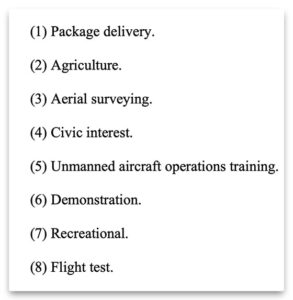
§108.405-§108.475 then goes on to the different types of fights that would fall under a “Permitted” 108 operations.
Including Recreational flights in §108.475. Those who have flown recreational BVLOS safely for years (you know who you are) can finally quit worrying about someone turning them into the FAA. And §108.475 has a number of exceptions that would be onerous to any recreational flyer trying to obtain their part 108 Permit. And yes, as written those flying under 44809 can get a permit to fly BLVOS. And we should use those same exemptions under §108.450 (Aerial surveying operations), but more on that later.
We’ll revisit Part 108 Permitting requirements in just a bit, because that’s where my beef is. And very likely the beef of just about every other drone pilot in the country.
What about Part 108 Certificated operations?
This is where the NPRM shines. If someone wants to fly even more complex missions, the FAA has set aside a Part 108 Certificate application process. You can find all of that in Subpart E. Certificated operations would include more complex delivery flights, as well as longer and more complex missions all listed above. It just adds a layer of complexity to the training and requirements since they’d be taking place in more congested environments.
I strongly suggest that you familiarize yourself with Subpart E, and all of it’s subsections. That would be from §108.500-§108.585. Those sections goes into great detail about who and what would qualify under a Certificated 108 operation. There is some great information in those parts, but I’m not going to go into detail in this article. DSPA is geared more towards the small and medium sized drone businesses. The larger companies are the ones who are going to be flying the majority of the flights taken under a Part 108 Certificate. And those folks just aren’t who DSPA truly represents.
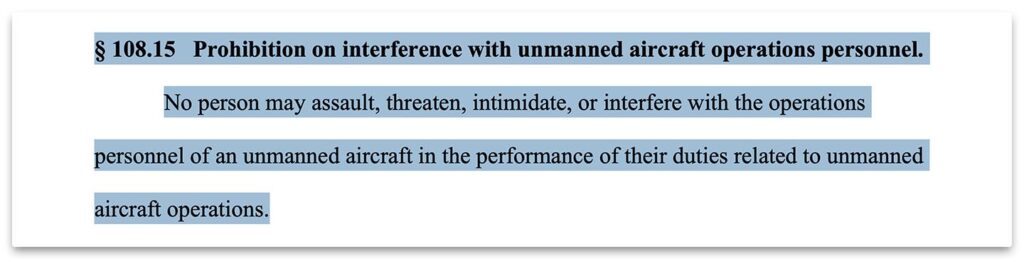
Before I dive into the parts I don’t like, I want to briefly talk about the part I like the most, and one that’s been needed in this industry for years. I’m talking about is Section $ 108.15. It’s short and sweet. It simply states, “No person may assault, threaten, intimidate, or interfere with the operations personnel of an unmanned aircraft in the performance of their duties related to unmanned aircraft operations.” Thank you for this FAA. We need it desperately. There is no Federal Regulation that protect us from idiots and wannabe civilian “drone cops” that think they know more than we do. We need this. Thank the FAA for this in your comments!
_____________________________________________________________________
I want to concentrate on what changes need to be made to this NPRM so that it would actually benefit the 99% of us who won’t be flying those missions described in the Certification process in Subpart E. I’ll get to that in a moment.
_____________________________________________________________________
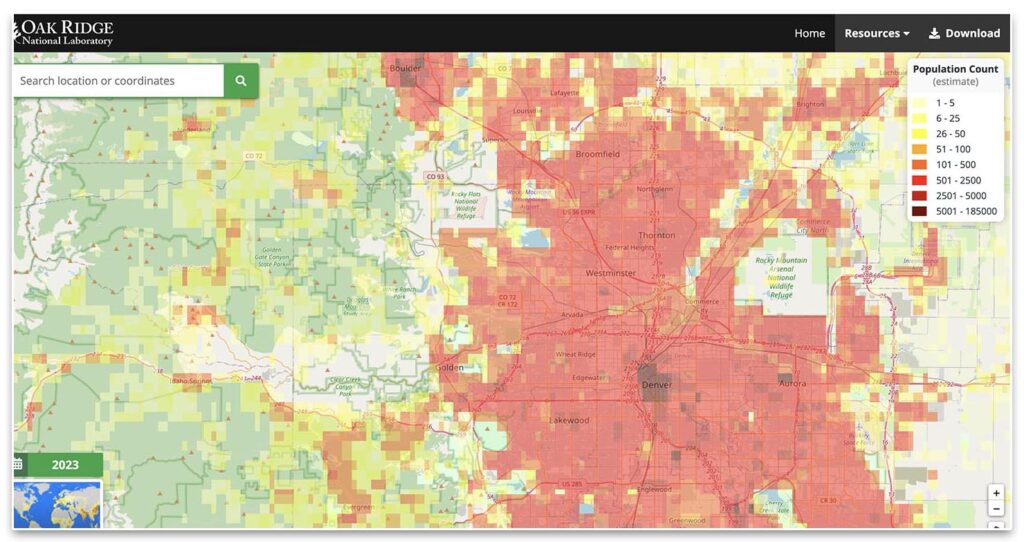
The first part of the NPMR I don’t like is the population density categories. They are way too strict. And we need to address this.
The NPRM talks about Operations of People (§108.185) and includes five different categories of population density. And those categories are used throughout 108 to determine what operations can be flown in what areas.
All operations that would take place under the Part 108 Permits (the lesser degree of complexity) will need to be done in Category 1 through Category 3 population density areas. Basically they define the highest category we could fly Permitted Part 108 flights within “1 statute mile of a cell of 25 people or higher.”
As mentioned, in §108.185, there are 5 categories for population density as defined by The Oak Ridge National Laboratories. If you look at the graphic above, this represents the area I live in (metro Denver). And it’s very typical of all urban areas. Those are the areas most of us fly. For me, I wouldn’t be allowed to fly any Permitted BVLOS flights in this area. And I already can under my §107.31 waiver. So this is literally a step back for me and everyone else who has a §107.31 waiver.
Flights taken under §108.450 can only take place”Within 1 statute mile of a cell of 25 people or higher”. In that map above, that’s the mid yellow color. Pull up the map and take a look at your area. Is there any place near your business where you can fly just 1/2 miles BVLOS? Better yet, take a look at a small town near you and see if you can fly there?
This is an overly restrictive limitation for any flight taken under EVLOS conditions. And very limiting for commercial DSPs. We can’t do our jobs if §108.450 ends up as written into the Final Rule as it is in the NPRM.
Please mention this is your comments.
That’s a major issue for anyone flying under a Permitted Part 108 flight. And flying BVLOS under 107 will no longer be permitted or waiverable.
_____________________________________________________________________
Which brings us to what is wrong, drastically wrong, with the BVLOS NPRM. And this, in my opinion, is what all of us need to concentrate on. It’s up to us to make sure this cannot be part of the final rule.
Let’s dive in.
First, let’s define what 14 CFR §107.31 (VLOS rules) are. Unless we have a waiver, we as RPIC must maintain the ability to see the sUAS in flight. And/or your VO must maintain that ability. And if you are using a VO, at least one of you must have eyes on the drone at all times. You can momentarily glance down at your controller if you’re flying solo, or the drone can momentarily go behind a tree of building and you’d still be legal. And you must be able to ensure the safety of all on the ground in the air while you’re flying.
The issues is that it’s simple to fly safely, but illegally, by the rules as written. If you’re flying a DJI Mini 4 around, you’re technically BLVOS in a big hurry. It’s very easy to lose sight of the drone at relatively short distances. That needs to be addressed in your comments.
Requiring a Remote Pilot to get a 108 Permit to fly a Mini 4 Pro 250 yards away is absolute rubbish. We know the flight is safe, and we know there is little to no danger (is any drone flight truly 100% safe?) to anyone on the ground around it. Or flying in the skies near it.
But if we don’t see changes to §107.31, and/or make changes to the Part 108 Final Rule, the FAA is missing an incredible chance to make Line of Sight rules actually mirror real world scenarios. This would be a good time to diplomatically mention that the language of §107.31 is unworkable in it’s current state, and the requirements of obtaining a BVLOS Permit under §108.400 are unworkable for small and medium size DSPs.
The BVLOS NPRM is missing an entire middle section of BVLOS flights. And that is where the vast majority of BVLOS flights take place. This must be addressed clearly in your comments.
I would suggest that (in your own words) you mention that §108.475 has exceptions for recreational flyers. And those same exceptions should apply to short distance (<3SM?) flights taking place under $108.450. Because if recreational have those exceptions, yet less training than a Remote Pilot has, we should have the same ability to fly BVLOS. And no, I’m not throwing recreational pilots under the bus here. I want them to have BVLOS capabilities. But the discrepancy between .475 and .450 is completely unfair to those who only need to fly short but BVLOS distance for videos, or stills, or mapping/measuring/ag missions.
The BVLOS ARC Final Report calls for the ability to have what they call “Extended Visual Line of Sight” (EVLOS) for flights up to 3SM. Personally I feel two miles is safer, but I’m a pretty conservative guy when it comes to safety of the NAS. But I trust those on the ARC, and they suggested 3SM. Use that if you want.
My BVLOS Waiver is for 2SM, which is my comfort level. I’m sure there are Remote Pilots who are comfortable at 3SM. But I also know there are some who are uncomfortable at even 1/2 mile. Use your best judgment here.
And speaking of waivers, if you have a BVLOS waiver under §107.31, it goes away once the new rules go into affect. And you can’t get a new waiver under §107.31. So unless we can get that changed in the Final Rule, we lose the ability to continue our safe flights we are already taking under our waivers.
This is a huge step back for our industry. We can’t let that happen.
Let’s dive in and talk about what is required to apply for a BVLOS Permit (for the less complex flights). You’ll find all of that in Subpart D (§108.405). This is where we really need to concentrate our energies as Remote Pilots.
In order to apply for a Part 108 Permit, you must supply the following (except for recreational flyers):
~The applicant’s name and contact information (physical address, email address, telephone number, and name of individual who serves as the point of contact).
~Address of the principal base of operations, if different from the address provided for contact information, in accordance with §108.30.
~Name of the individual(s) who serve(s) as operations supervisor, in accordance with § 108.305, unless operating under a recreational permit in accordance with § 108.475.
~The intended type of UAS operation(s), in accordance with § 108.400(a).
~The intended area(s) of operations, in accordance with §108.165.
~Company manual(s), as required under § 108.135.
~A record keeping process as required under §108.40.
~Operator reporting procedures, as required under §108.45.
~The type(s) of unmanned aircraft to be used in operations, that comply with the requirements of §108.105.
… and…
~Additional information the Administrator may determine is necessary to evaluate the application.
Some of this is obviously a no-brainer to do for the average DSP. But if you’re a single operator, or one with just a handful of pilots, who are you going to pay to write your manual? It’s very complicated. What record keeping will you be able to reasonably maintain. Look at the requirements under §108.40 and § 108.135. They’re both a small business record keeping nightmare. And guess what happens if you’re ramp checked and you have none of that. My current Policy and Procedure manual is close to 125 pages long. And that doesn’t include the Airspace Authorizations I have in order to fly with my waivers in controlled airspace. I have those stored on my desk, and pull out the ones I need for that day. How many volumes will I need to carry to fly with a 108 Permit?
Take a look at both of those requirements and comment accordingly.
We must include some of the language of EVLOS as mentioned in the BVLOS ARC in our comments. Otherwise, this NPRM actually destroys some of the advancements we’ve made of the last couple of years when it comes to legal and safe EVLOS flights under §107.
Short distance EVLOS flights taken under §108.450 must have the same exceptions as recreational BVLOS flights under §108.475. Recreational operators are not required to have ops manual (108.130 & 108.135), experience requirements (§108.310), a principal place of operation, designated supervisor (§108.305), Cybersecurity (§108.435), nor duty and rest requirements (§108.330). Yet they can fly up to 10 miles from the flight coordinator (RPIC in our case). And the ARC report suggested a measly 3SM for EVLOS flights. Under 107.
That is patently unfair to the current 107 community members that have permissions already to fly under waivers for §107.31. As mentioned, it’s a huge step backwards for our industry. The FAA bases their rule changes on data. They need to take a hard look at the data of our legal (& illegal) BVLOS flights and make sure we can keep our current permissions in place. We can’t go backwards.
Here is a great graphic from Commercial Drone Alliance. Follow this formula, and your comments will be received much better.
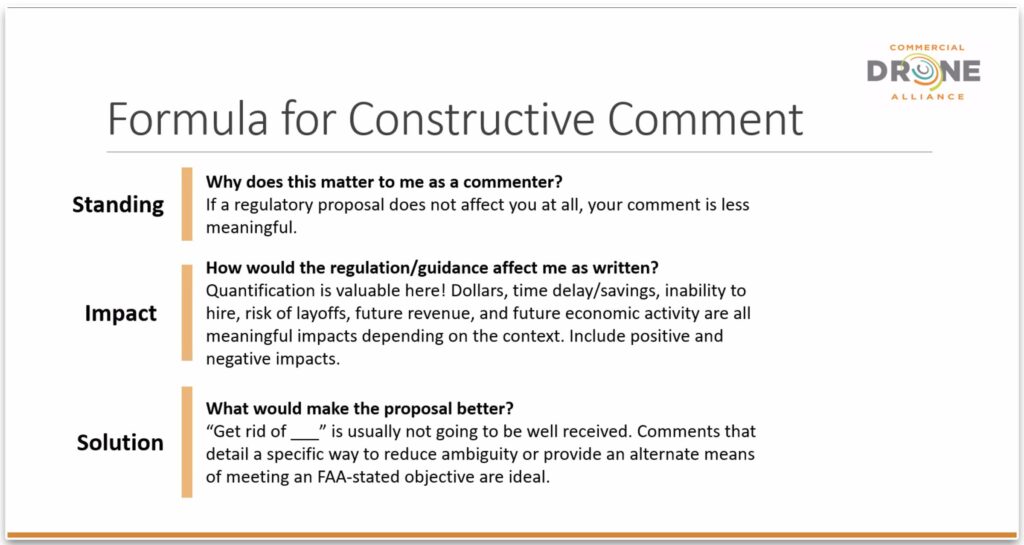
A couple of other suggestions for writing your comments.
First, if you use ChatGPT (many do, and it works well) to help you craft your responses, make sure you analyze the answer it gives you. While it’s a good tool, don’t use it as a crutch.
Second, refer to the preamble for your answers. The FAA actually asks what answers they are looking for. If you response doesn’t cover their request, it’s not a good answer.
Third, as tempting as it is, keep the comment professional. Trust me, I completely understand how tempting it is to be snarky. But that will actually hurt you.
Fourth, be succinct. Get your point across, but use two words when two words are required. Don’t use 10 words when two words are required. Someone has to read your comment. Don’t make their job difficult.
Fifth, tell your story in first person voice. Tell the reader what would happen to you if you can’t do your job. Do you fly recreationally as well as commercially? Mention that. Do you work with kids, or fly with your own? Mention that. Do you have a §107.31 waiver and routinely fly BVLOS currently? Mention that, and mention what would happen to your ability to get the clients the data or imagery they need if that was taken away from you.
Sixth, give them answers. Don’t just complain about something, offer an alternative.
Lastly, share this with every other pilot and flyer you know. This affects every person who flies drones. And the way it is currently written, it only benefits less than 1% of the drone operations out there.
We can’t go backwards. This NPRM is touted as an advancement for the UAS industry. And much of it is. But for the small and medium sized drone companies, this is a giant leap backwards. It removes what we can already do safely and legally, and makes it basically impossible for us to comply with the onerous requirements of a permit application.
This can’t become law. Not the way it’s currently written. It just can’t.
*views expressed in this article do not necessarily reflect those of CDA and its board or other members.
_____________________________________________________________________
Drone Service Providers Alliance provides “Professional advocacy for Drone Service Providers throughout the United States”. Our mission statement is “A United Voice for Positive Change”. We are a dues supported 501(c)(6) organization. Dues are used to cover travel and operating expenses. No salaries are taken by Kenji and Vic for the work they do on behalf of the U.S. UAS industry. We fully believe a rising tide lifts all boats. And since we also fly drones for a living, our boats will rise as well.
If you believe in what we do, please consider joining us, we appreciate any and all support: https://dspalliance.org/join-us/
Also, have you added to your drone fleet? Do you know the ins and outs of your new drone? Check out Pilot Institute’s Deep Dive Videos. Greg and crew do an great job helping you understand your drone better. And each and every Deep Dive Video is free.
Also, if you don’t have your 107 yet, or are looking to add UAS Verticals, check out the Pilot Institute site for additional classes. They have business classes, a VO class (pay for your VOs to take it), mapping, photography, and more. Check out their offerings here!
Need a new drone? Need to rent one for a specific job? Need some repair work done? Blue Skies Drones is your answer to all of these questions.
And if you’re worried about the current anti-China fervor in D.C. and many states, please seriously consider joining Drone Advocacy Alliance. Let’s work together to stop Congress from picking industry winners and losers.
And as always FLY SAFE!
_____________________________________________________________________
Additional BVLOS NPRM summaries/videos: