Well, this “Request for Public Comments” is an interesting one. It seems to combine defense with private sector, and has some interesting “push poll” types questions. Those questions, (v) & (vi), assume some things that aren’t proven. And it’s focus is about the economic impact of this supposed “National Security Issue”.
B.S. in the title stands for the fact that since Whack-A-Mole in D.C. was already taken by another article, it’s just a continuation of the Bovine Scat this industry has to put up with time after time. When one political door is closed due to pushback or common sense, those with an unhealthy obsession with DJI (& those US manufacturers who can’t compete with DJI and have political clout) will try and open another one. It’s all Male Bovine Scat.
There is also some very noticeably absent words in BIS-2025-0059-0001 , the official docket number of this request. Nowhere in this request is China mentioned. Nor is “country of origin”, or the usual suspects, DJI & Autel mentioned. But I’d bet dollar to donuts, that’s exactly who the BIS had in mind when they put this out.
And the timing is rather interesting. Mr Joe Bartlett is now the Under Secretary of Bureau of Industry and Security (BIS) -U.S. Department of Commerce. And that is the agency that published this request. If Mr. Bartlett sounds familiar, this is why. He was the National Security Advisor to Representative Elise Stefanik from 9/21-1/23. He then became Skydio’s Director of Federal Policy from 11/23 until 1/25. After the election, he joined BIS in January of this year, and became the Under Secretary in June. And on July 1st, the BIS “… initiated an investigation to determine the effects on the national security of imports of unmanned aircraft systems…”
You can use your own judgement to decide if this is a tad too coincidental or not. But a source did tell me that Mr. Bartlett left Skydio under “less than friendly terms”. So maybe Mr. Bartlett has had a change of heart and is ready to put the industry before profits. We’ll see. But Mr. Bartlett has has a quite a run in D.C. and the private sector. He seems well qualified for the position of Under Secretary. Let’s hope he can separate past alliances with his current work when it comes to this “Request for Public Comments”.
So what does BIS want to hear from us about?
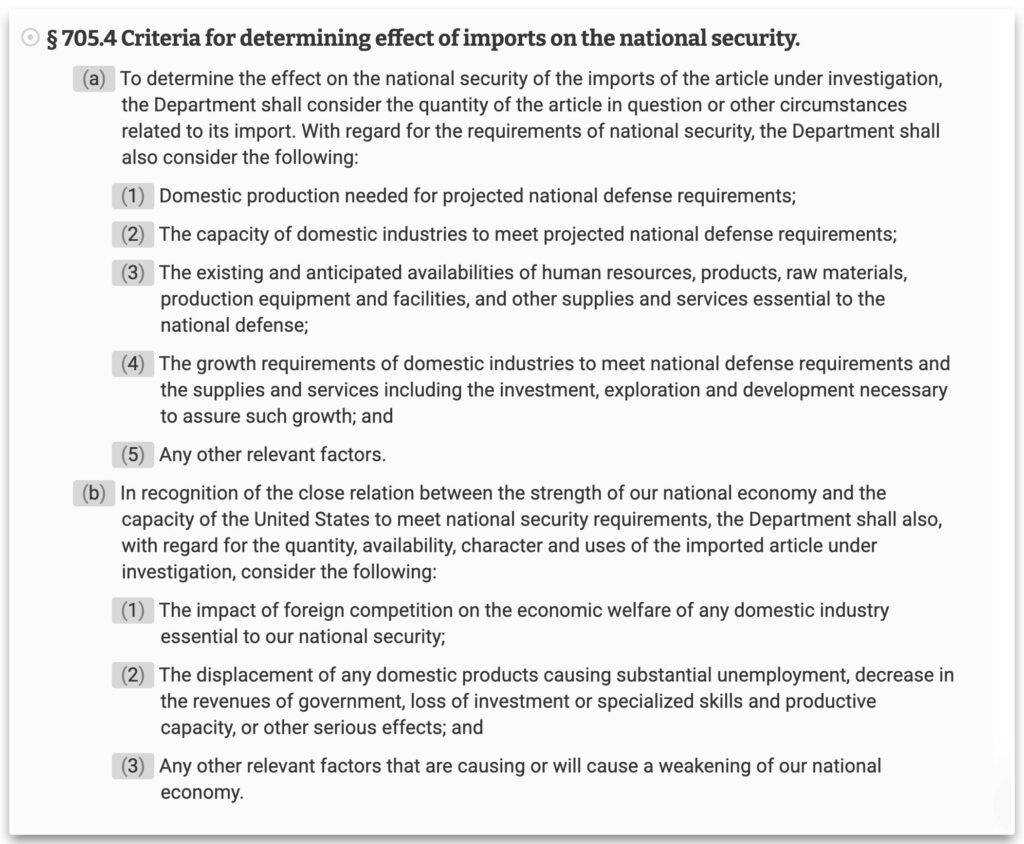
The request itself as 11 specific questions, and is “particularly interested in comments and information directed at the criteria listed in § 705.4. And §704.5 is titled “Criteria for determining effect of imports on the national security.” So you can read each of the 11 questions, and gear your comments towards answering the concerns in §705.4. At least to the best of your ability. There is no need to answer all 11, nor do you want to stray too far from the specific ask of each question.
If you have concerns about the impartiality of particular questions, feel free to mention that. Do so in a professional and diplomatic way, but feel free to state your concerns if they are legitimate.
Personally, the two questions I have grave concerns about are (v) & (vi). They both assume certain things exist (predatory trade practice, artificially suppressed prices, and unfair trade practices and state-sponsored overproduction) in the way they phrase the questions. The BIS outright assumes these happen. You can address that as you see fit. Again, diplomatically.
Below are the questions and some bullet point thoughts of mine. Don’t copy verbatim. If comments start to sound the same, they don’t hold the same weight as others. And don’t forget to add part of your own story to you answers. Especially if your answer to question (xi).
And remember, the BIS wants answers to these questions as it applies to 15 CFR §705.4. So read that, or print it out, and refer back to it as you craft your responses. Some answers will apply to multiple questions.
So say this before each question below, “The Department is particularly interested in comments and information directed at the criteria listed in § 705.4 of the regulations as they affect national security, including the following:”
_____________________________________________________________________
Question (i): the current and projected demand for UAS and their parts and components in the United States;
Bullet points.
- There is no proven correlation between ready to fly drones made outside the United States and national security.
- Until we have proof of any security connections between commercial and recreational use of non-domestic drones and national security, this is a concern in search for an actual issue.
- For the non-defense use cases, there is no ongoing connection between civilian use and national security.
Question (ii): the extent to which domestic production of UAS and their parts and components can meet domestic demand;
Bullet points:
- Not at all.
- And they won’t.
- We don’t have ability to get the raw materials we need.
- We don’t have the mechanical and computer engineers to design these drones even if we had the manufacturing capabilities.
- We don’t have the Venture Capitalists willing to invest in factories to produce consumer and prosumer drones.
- Over 90% of all commercial and almost 100% of all recreational drones are made in part of whole outside the United States.
- Virtually every component for recreational and FPV drones are made in China.
Question (ii): the role of foreign supply chains, particularly of major exporters, in meeting United States demand for UAS and their parts and components;
Bullet points:
- We rely on Chinese companies
- This is our own doing
- We’ve been offshoring manufacturing for the last 5 decades.
- We can’t wave a magic wand and make them come back
Question (iv): the concentration of U.S. imports of UAS and their parts and components from a small number of suppliers or foreign nations and the associated risks;
Bullet points:
- Similar answers as above
- The risk is obvious, if we can’t make it, we have to import it
- Every reasonable drone out there either comes from China, or is built under license from a Chinese drone company.
- Invest in Manufacturing
Question (v): the impact of foreign government subsidies and predatory trade practices on the competitiveness of the UAS and their parts and components industry, in the United States;
Bullet points:
- This is a push poll.
- The questions assumes there are predatory trade practices.
- Skydio and BRINC are the two most predatory companies around.
- They over promise and under deliver
- They use the legislative process since they can’t compete
- They sell to the bosses instead of the end users since the end users see past their lies.
- Where is the proof of any predatory practices?
- Skydio, BRINC, and other U.S. manufacturers get U.S. subsidies. Does that mean we are guilty?
Question (vi): the economic impact of artificially suppressed prices of UAS and their parts and components due to foreign unfair trade practices and state-sponsored overproduction;
Bullet point:
- Another push poll
- Assumes a fact when no proof is given
- Is this a legitimate question, or is the BIS fishing for support?
- Carefully craft your answer for this one and for (v) to ask what their end goal is.
- Or just don’t answer it.
Question (vii): the potential for foreign nations and companies to weaponize their control over supplies of UAS and their parts and components;
Bullet points:
- Why would they?
- Chinese drone companies are doing just fine controlling the industry.
- They do it with innovation and lower costs.
- China put a number of U.S. drone manufacturers on an entity list.
- But it was retaliatory, not predatory.
- They pushed back against Skydio in particular because of Adam Bry’s outlandish and very public attacks against the Chinese government and DJI in particular.
- Why wound’t China do that?If you kick a bull in the nether regions long enough, it will turn around and give you his horns.
- The U.S. is doing that very thing right now via tariffs.
- Where is the difference?
- If it got to the point where DJI and Autel no longer sold in the U.S. due to a war, then drones would be at the bottom of things to worry about.
- Insert some logic and common sense to this argument.
Question (viii): the potential for foreign nations and companies to weaponize the capabilities or attributes of foreign-built UAS systems and their parts or components;
Bullet points:
- In order to gain control of an aircraft, you need access.
- If you’re not connected to the internet, you can’t gain access.
- In order for Skydio’s to fly, they need to be connected to the internet for many of the missions.
- It’s a very simple thing to protect against this with air gapping and other measures.
- This is an overblown fear, based on politics, not facts.
Question (ix): the feasibility of increasing domestic capacity for UAS and their parts and components to reduce import reliance;
Bullet points:
- Completely infeasible.
- We don’t have the capital to build plants
- We don’t have the workforce to design and assemble drones
- We don’t have access to the deposits of raw resources we need.
- Waiting for EPA approval alone would put us further behind.
- We don’t have chip plants for drones
Question (x): the impact of current trade policies on domestic production of UAS and their parts and components, and whether additional measures, including tariffs or quotas, are necessary to protect national security; and
Bullet points:
- Tariffs are not tied to national security.
- Tariffs are about money, not security
- Quotas are simply price fixing.
- Economics 101 dictate that reducing the supply increases the cost of the item
- There is no reason for tariffs if national security it the end game
Question (xi): any other relevant factors.
Bullet points:
- Here you can give them some alternatives.
- Security measures
- Wait for the 1709 audit.
- Don’t do anything until the 2209 list is published and active
- Define where we aren’t allowed to fly
- We are a county of laws telling us what we can’t do, not a list of decrees telling us what we can do. That’s either a Monarchy or a Theocracy
- Tell what will happen to your company of hobby if we can’t get these parts or drones
- What will happen to the aviation industry?
- Prove it’s an issue
_____________________________________________________________________
So read the Request for Comments, choose which of the questions you’d like to answer, and sit down and write a well thought out and professional response. Include what might be an alternative to this. Be succinct and be relevant. “This Sucks” is not a helpful response. Neither are comments about government overreach. And we see both of those frequently.
So take the time to do it right. It’s imperative that you do. And take the time to look at some other sources for more inspiration. Mine is not the only one you should use.
Some things to mention:
- This country doesn’t have the manufacturing capabilities to produce enough drones to replace the supply from China.
- Security measures an easy way to combat any perceived security threat.
- Chines drones run the economic engine of this industry.
- The U.S. drone industry is predicted to be a $52.5B industry by 2023.
- If Chinese drones are banned or severely limited, that will have a drastic impact on that prediction.
- Mention the only time China has placed US drone manufacturers on any list was in retaliation for repeated calls from the leaders of those companies that China needs to be sanctioned, or even banned when it comes to the UAS market.
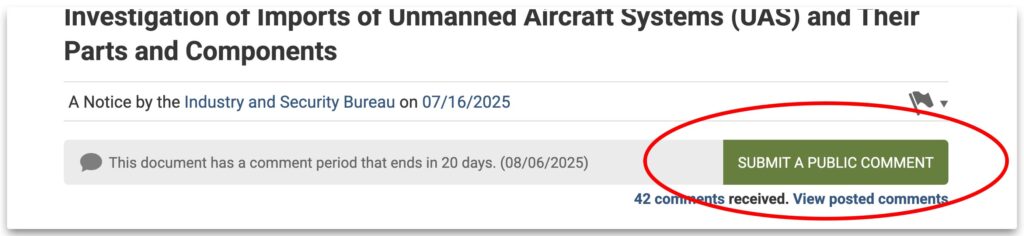
Once you have your comments written go back to the Federal Register Page and click the green “SUBMIT A PUBLIC COMMENT” link and fill that out. You can either submit a PDF, or copy and paste your comments into the comment box. I suggest the latter. That way there isn’t the possible issue of them not being able to open the PDF.
_____________________________________________________________________
And when I reached out to DJI for an official response to this, I received this:
“We encourage the Department of Commerce to carefully consider the substantial impact that any disruptions to the current supply chain would have on American small businesses, public safety agencies, and the broader drone industry. DJI drones have been subject to tariffs since 2017, and any additional costs could place significant burdens on small businesses, hinder the growth of the American drone industry, and disrupt the U.S. drone ecosystem that we have continually supported.
The U.S. drone industry includes not just manufacturers but also service providers, software developers, and commercial operators, many of whom rely on DJI products. These products generate more than $116 billion in economic activity across the country and support over 450,000 American jobs. It is essential to recognize the critical role that DJI plays in fostering innovation, saving lives, and supporting the livelihoods of countless individuals across America. We believe that a thoughtful and balanced approach is necessary to ensure the continued growth of the U.S. drone industry.”