
What can we do?
If you’re reading this, you already understand that a coordinated, multi-front assault is underway against the commercial and recreational UAS communities in this country. This effort is not limited to Washington, D.C., it is also unfolding across numerous states and federal agencies.
Fortunately, multiple response avenues are already in motion. Advocacy campaigns through the Drone Advocacy Alliance’s “Take Action” page have helped connect pilots with their elected officials. Many individuals have reached out directly to members of Congress—thank you for doing that. Industry groups and UAS companies have also scheduled meetings with both legislative and executive branch leaders.
Now, the Drone Service Providers Alliance (DSPA) is adding another critical avenue: direct engagement with the White House.
This effort is not intended to replace existing initiatives. Instead, it adds a top-down approach to complement the bottom-up pressure already being applied. The more pathways we use to communicate our concerns, the better our chances of influencing meaningful change.
How to Contact the White House
Did you know you can submit comments directly to the White House?
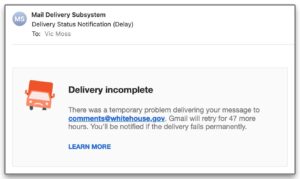
Up until recently, there was an actual email address for this. It was comments@whitehouse.gov. But it seems to be inactive now. So this leaves us with the “Contact Us” page on the official White House website.
We’ve been getting the following bounce over our last few attempts:
Instead, use the White House “Contact Us” Portal
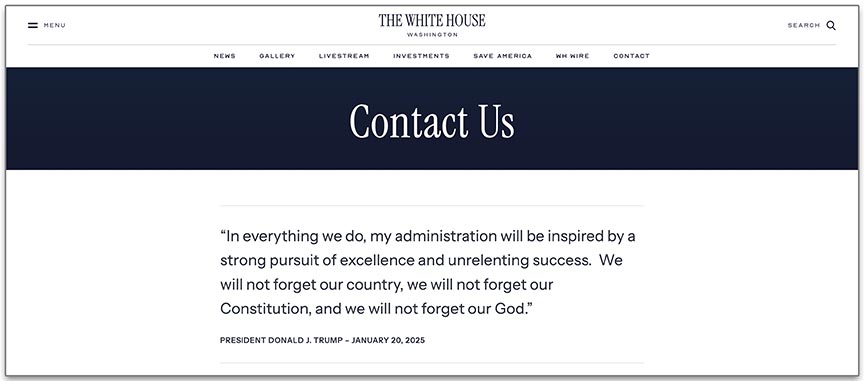
The preferred method is the official contact form at: https://www.whitehouse.gov/contact/
While the portal limits submissions to 4,000 characters, that is more than enough space to deliver a compelling, well-structured message. Links are allowed, and when used strategically, they can be effective. The main drawback is the amount of personal information required, but for many of us, transparency is a reasonable trade-off for impact. For reference, this article has a tad over 9200 characters. So you can still say a lot with the 4000 character limit. Watch your character count in Word or Pages as you write your comment.
What to Say and How to Say It
Before writing, take time to think through both your message and your tone. This is not the place for venting or political attacks. It is the place for clear, professional, fact-based advocacy.
Start With a Story
Begin with a brief personal explanation of what drones mean to you:
- Do you operate a drone business?
- Fly recreationally?
- Work for a first responder agency?
- Use drones in education?
- Run a retail outlet that can no longer get product?
A paragraph or two is enough. Be concise, authentic, and specific. Emotional impact matters, but being concise matters more.
Avoid Templates
Template emails are easy to spot and largely ineffective. Unique messages carry far more weight. Especially if they include that personal story. Draft your response in a word processor first, then copy and paste it into the portal once finalized.
Using tools like ChatGPT to polish grammar and flow is perfectly acceptable. Just edit it to ensure the final version sounds like you. M-dashes and random BOLD names are a dead giveaway. Overly formatted or generic AI language is easy to spot by those reading these comments.
Key Issues to Address:
Choose one or two of the following topics per submission. If you want to address more, submit multiple comments. Remember, you have to work with that 4000 character limit.
FCC Ruling (December 22, 2025)
The FCC’s recent actions severely limit the ability of operators to replace existing drone fleets with comparable equipment. While innovation abroad continues unabated, U.S. operators are left without affordable or capable alternatives. No American or allied manufacturers currently offer replacements for the majority of use cases. Nor is American manufacturing currently capable of producing the millions of replacement drones that would be required within the next two to three years if access to new aircraft from China is cut off. Aging fleets still need to be replaced, and there is no domestic supply chain prepared to meet that demand on the proposed timelines. Any legislation that restricts access to Chinese-made drones must also acknowledge that basic reality.
The result will be that U.S. drone operators will continue to fall behind while the rest of the world moves forward.
CBP Seizure of DJI Shipments
Beginning in late 2024, U.S. Customs and Border Protection began seizing DJI shipments under allegations related to the Uyghur Forced Labor Prevention Act. DJI has addressed every concern raised but has received only generic denial letters in response. They have been given no specific guidance on alleged deficiencies.
The seizure of DJI drone shipments by U.S. Customs and Border Protection (CBP) has significantly disrupted the U.S. drone market. By detaining imports from DJI at ports of entry, CBP effectively halted the flow of new aircraft, replacement parts, and repair components into the country. Because DJI holds a dominant share of the U.S. commercial and public safety drone market, even short-term import interruptions have immediate and widespread consequences.
The impact has been felt across law enforcement, fire departments, infrastructure inspection firms, construction companies, and every day Drone Service Providers. Agencies and companies relying on DJI platforms have faced delays in acquiring new drones, difficulty sourcing batteries and critical components, and extended repair turnaround times. In some cases, fleets have been partially grounded due to the inability to obtain manufacturer-approved parts through authorized channels.
This single enforcement action has been the primary driver of the current supply disruption. Unlike broader trade tensions or export controls that affect global supply chains incrementally, detentions at the U.S. border directly choke off inbound inventory. In a market heavily dependent on one manufacturer, stopping shipments at the point of entry can quickly constrain both new acquisitions and the maintenance of existing fleets.
Without transparency, remediation is impossible. Meanwhile, businesses and public agencies suffer real operational harm.
Pilot Institute Survey Results
Summarize key findings from the Pilot Institute survey and maybe include a link to the summary video. But do include a link to the white paper download. I do strongly suggest you download that white paper yourself though. It’s full of great information. However, government officials are far more likely to click a video link than complete a form to download a document.
American Security Drone Act (ASDA)
Signed into law as part of the FY2024 NDAA, the ASDA imposed a two-year deadline for agencies to replace drones manufactured by “covered foreign entities.” That deadline passed on December 22, 2025. And not a single viable replacement became available in the timeline demanded by the ASDA. All because the ASDA forbid the use of those drones for any project using federal funds. And virtually all highways use federal funds in part or whole. As a result, multiple Departments of Transportation have severely reduced their usable drone fleets, and in some cases have grounded drone programs entirely.
This outcome was explicitly predicted in the GAO’s September 25, 2024 report “Federal Lands:Effects of Interior’s Policies on Foreign-Made Drones“. That report documents halted missions, canceled wildlife surveys, and restricted university research due to the DOI’s restricted use of drone from “Covered Entities”. And that was the direct effect of this type of legislation on just one single federal agency.
The outcome of similar legislation is summed up in the final paragraph of the reports findings: “Interior’s drone policies have also prohibited other entities from operating certain foreign-made drones on Interior-managed land. As a result, the National Oceanic and Atmospheric Administration (NOAA) altered or ceased some of its drone missions for wildlife surveys on Interior-managed lands, according to NOAA officials. In addition, Interior’s nonfederal partners, such as universities, often do not have drones that comply with Interior’s policies. Consequently, such entities can no longer fly missions on Interior-managed lands for purposes such as monitoring wildlife populations and evaluating archaeological sites, Interior officials said.”
And finally, the Section 1709 Security Audit
And of course we all would still like the White House to mandate a security agency to perform the required audit under Section 1709 of the FY2025 NDAA.
The Ask: What We Need the Executive Office to Do:
Rolling back all restrictions is unrealistic—and not always appropriate. But fact-based governance should be non-negotiable.
The most urgent action is the mandatory security audit required under Section 1709 of the FY2025 NDAA. The White House must assign a qualified security agency to conduct this audit and publish its findings, as required by law.
Until that audit is completed, existing restrictions are not grounded in evidence. Instead they are grounded in fear, misinformation, and competitive pressure.
The President can:
- Assign and mandate completion of the Section 1709 audit
- Require a public report, as the statute demands
- Direct the FCC and Department of Commerce to revise drone restrictions to be based on factual findings
Trade Talks
As the White House prepares for upcoming trade talks between President Donald Trump and President Xi Jinping this April, one critical industry must not be overlooked: unmanned aircraft systems. Commercial and recreational drones are essential tools for thousands of American small businesses in construction, agriculture, inspection, public safety, media, and mapping. For many operators, companies such as DJI provide the core platforms that make their work possible.
The UAS industry cannot survive without reliable access to these tools. Sudden restrictions that limit or eliminate access to widely used drone platforms would disrupt operations (as we’ve seen with the CBP actions), threaten small businesses, and weaken America’s competitive position in a rapidly growing sector. While national security concerns deserve serious attention, solutions must balance security with economic practicality and provide a clear, workable pathway for continued market access.
Trade negotiations also present an opportunity to encourage leading drone manufacturers to establish production facilities in the United States. Domestic manufacturing would strengthen supply chains, create American jobs, and support skilled workers while ensuring continued access to critical technology. Including the UAS sector in these talks would protect small businesses and advance the broader goal of strengthening American industry. This issue has been at the forefront of the administration’s agenda since the campaign.
Ask the White House to include this important aspect of the U.S. economy in the trade talks schedule. It’s a win/win scenario.
Why This Matters Beyond Drones
Drones are increasingly becoming the gateway to aviation careers. Middle and high schools across the country now use UAS programs as STEM pathways. Colleges are launching UAS-specific curricula. And restricting access to affordable, capable drones threatens to close one of the most effective entry points into aviation at a time when the industry desperately needs new talent. Pilot and aviation mechanic shortages are well documented, and drones are the best opportunity to spark that love of aviation in our students and young adults.
Final Thoughts
Professionalism matters. One poorly written or hostile comment can undermine an otherwise compelling case. Your comment to the White House should not be about attacking individual companies or organizations that support these current restrictions and roadblocks. It should be about ensuring that the people most affected by these decisions have a meaningful voice. Logic and common sense are critically, and even tragically absent in the conversation.
Nor is this about preferring Chinese drones over American drones. It’s about access to safe, secure, affordable, and effective tools, regardless of country of origin. Security should be evaluated based on performance and architecture, not nationality alone.
When governments chooses winners and losers without any public evidence, it undermines competition, innovation, and the very principles that have built American industries in the past. It should be no different in building today’s emerging industries.
Please take the time to make your voice heard. It matters tremendously!
Thanks!


Great article and informative. WH contacted