The most important piece of UAS legislation to come out of Washington D.C. since we were given Part 107 in 2016 is currently requesting comments.
Unless you’ve been living under a rock since August 8th, this isn’t news to you. And it’s not likely news to you that it’s very long, and includes a multitude of parts. Additionally, it’s very likely not news to you that it’s not what we as Remote Pilots wanted at all.
This legislation I’m talking about is obviously the “Normalizing Unmanned Aircraft Systems Beyond Visual Line of Sight Operations”, better known as the BVLOS NPRM.
This article, along with others, will help you navigate that 180 page, triple column, 12 point document as it’s published in the Federal Register.
But first, before you start reading this, download this version of the NPRM. It’s much easier to read. This is actually a single column PDF that makes it much easier to read. It does make it 409 pages, but it’s still easier to read. So download that and use it to follow along with this article. I’ll refer to certain page numbers of that PDF throughout this article.
A little tidbit about PDF. Use the Adobe Acrobat search function if you need to see a specific part. Hit “Command + F” on a Mac, or “Crtl + F” on a PC. Type in your search string and it will find those references. In a PDF this large, you may need to refine that string.
Let’s start with the elephant in the room. And that’s the fact that under the rules proposed by 14 CFR §108, those flying under §107 would no longer be able to apply for a waiver under 14 CFR §107.31. On page 136, the preamble states, “Operators conducting photography, videography, mapping, inspection, and patrolling with UAS are currently doing so either under the confines of part 107 VLOS operations, under a waiver to proposed §107.31, or by relief granted through an exemption allowing for aircraft weighing more than 55 pounds or BVLOS operations. FAA proposes in § 108.450(a) that operators would be able to conduct photography, videography, mapping, inspection, and patrolling under an operating permit.”
In simply English, the FAA wants to move ALL BVLOS flights to §108. Obtaining a waiver under §107.31 will no longer be an option. And since all flights taken under §108 will no longer be able to fly manually, or use a standard controller at all, this completely removes the ability for any BVLOS flights as we fly them now. This will set us back years. There are currently 648 §107.31 Waivers listed in the FAA’s Part 107 Waivers Issues page. SO those would all go away.
And with the application requirements listed under § 108.450 (Page 355), no current Remote Pilot qualifies. And there is no mention if the FAA would cancel the 648 existing §107.31 waivers, or allow them to expire and transfer those flight requirements over to §108.450. That remains to be seen.
But rather than make this article longer than it already will be, DSPA and others have been working with Pilot Institute to put out a call for action to ask the FAA to provide relief from §108 for those low risk operations that already have a proven safety record under §107.41 and Part 91 waivers. You can find all of that information in a YouTube video by Pilot Institute. In the description part of that video are also our UAS Coalition comment to be published later this month, along with another bullet point list. There is also a link if you want to become a signatory of that comment. We have opened it up to anyone who wants to be part of this. And if you agree with what we came up with, please do sign on to our comment. The more industry signatories we have on that document, the more likely those who write the Final Rule will be to listen to us.
So watch the video, read the Coalition NPRM Comment and Toolkit: Key Points for FAA BVLOS NPRM Comments, and get that info there. By the way, if you agree with our joint comment, you’re more than welcome to add your company’s name to it. The more we have, the more credence this will have with those who are writing the Final Comment.
For this article, I’ll be highlighting some additional points. So use both (& others) to craft your comment. And if you only have time to use one resource, quit reading this article and use the Pilot Institute video and article.
_____________________________________________________________________
Here is an example of how to start your letter/comment. Use this to ensure your comment looks professional:
September X, 2025
Docket Operations, M-30
U.S. Department of Transportation
1200 New Jersey Ave. SE
Room W12-140, West Building Ground Floor
Washington, DC 20590-0001
Delivered electronically via www.regulations.gov.
RE: DOCKET NO. FAA–2025–1908 NOTICE OF PROPOSED RULEMAKING
_____________________________________________________________________
The body of your letter/comment should be broken down into three parts. Tell them what you’re about to tell them (introduction), tell them what you want to tell them (the body), and then tell them what you told them (summary).
The introduction should also include a brief description of you and/or your company. Mention what you currently do with UAS, or plan on doing in the future (especially if those plans include future BVLOS flights under 107), and how this would affect your business. Do go into detail, but be specific.
Also, if you feel you are going to end up commenting on a lot of different aspect of the NPRM, I suggest your send in two or three separate, shorter comments instead of one larger one. Someone will read that comment. Professionals at the FAA, such as policy officials, technical experts, and subject matter specialists, read and analyze the public comments received. So you need to make it easy for them to do their jobs. And it’s much easier to summarize a shorter comment that contains just a few talking points than a large comment with multiple talking points.
Put yourself in the head of the reader. Make it easier for them. They’ll have a lot of comments to read. I have no doubt they’ll appreciate that. And they’ll be more accurate with their summarization.
_____________________________________________________________________
Okay, here is the part where I’ll talk about certain aspect of the NPRM, the issues, and comments about a fix.
The Good
Here is where you want to set the stage for providing professionalism in your commenting. Starting with the good parts of the NPRM and thanking them for this is a great way to put the reader at ease. Odds are they’ve read many comments that simply complain. Give them a break from that with your comments.

§ 108.15. Prohibition on interference with unmanned aircraft operations personnel (page 330).
No person may assault, threaten, intimidate, or interfere with the operations personnel of an unmanned aircraft in the performance of their duties related to unmanned aircraft operations.
While this comment is directed at Part 108 operations specifically, the wording does not restrict enforcement to those flights that take place under Part 108. Even in the preamble under the “Part 107 – Small Unmanned Aircraft Systems” heading (Column 3, page 38318 as published in the Federal Register)
The overall intent of §108 is to provide a methodology in the rule for large scale, repeatable, and scalable BVLOS operations. Which is needed to this industry to continue to grow. Mention something about the need of this rule, and that it’s imperative that this rule take into account the overall safety of the NAS.
_____________________________________________________________________
The Bad
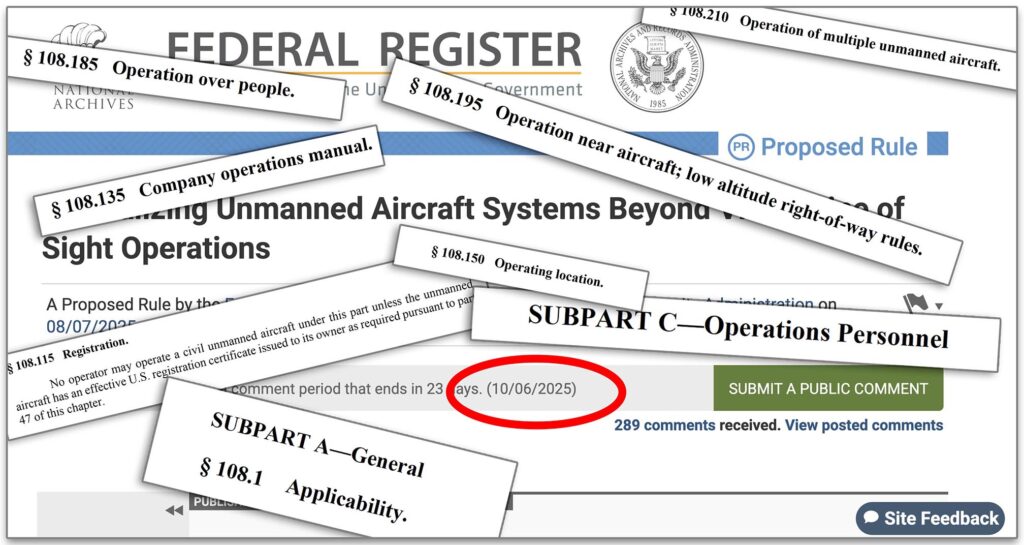
Here is where you’ll likely spend the vast majority of your comment writing. I’m going to simply go through some of the more important parts in order. You can comment on some of them or all of them. And again, I can’t emphasize enough that this article should just be one of many you use to craft your comments.
First and foremost, the vast majority of this NPRM decimate Part 107 BLVOS operations. There is such a chasm between our current BVLOS rules under § 107.31 and what is required to fly under §108, it’s insurmountable. We need to hammer this home.
The FAA wants to take all BVLOS flights and put them under the auspices of § 108, and the requirements for apply for a permit or certificate are so onerous, it’s puts them out of the realm of possibility for the small and medium sized DSP companies to obtain. While I understand the intent or this, the actual real world ramification would put our industry back a minimum of 2 years. Look at the advancements we’ve made in 107 BVLOS ops over the last 24 months. All of that would be erased.
Another incredibly tragic part of the BVLOS NPRM is that it is geared towards autonomous flights only. No more “flying” BVLOS under § 107. If we fly using out controllers instead of completely autonomous programming, we are NOT allowed to fly under § 108.
There will no longer be any Remote Pilots in the loop. A Remote Pilot Certificate isn’t even required to do any of the jobs listed under SUBPART C. More on that further down.
SUBPART A—General § 108.1 Applicability (Page 327).
This section sets the basis and definitions for the rest of § 108. Read through it and mark some parts that you like or dislike. You’ll refer to them in your comments. Hint here: If you are reading the specific section of § 108 as you prepare your comments and want to see why the FAA came up with that, use the search function in Adobe Acrobat and search through the preamble to find where they talk about it. Many times there are specific questions about that section in the preamble. Answering those questions are paramount to a good submission.
SUBPART B is where you’ll find the meat and potatoes of this NPRM. Here is where you want to spend the major of your time. You’ll find it at the end of the NPRM language.
Keep in mind that these regulations are large UAS operations in mind. And by “large”, I mean those companies that fly a large number of UAS, and/or large aircraft themselves. Also, much of the security you see mentioned are due to the package delivery of many of those companies.
§ 108.115 Registration (Page 338).
Here is where you’ll find the first issue. § 108 requires all drones flown under this section to use the antiquated Part 47 registration process. This is better known as “N Number” registration, and applies to all manned aircraft. And some UAS that are above the 55 lbs limit for Part 48. Part 48 caps the UAS weight at 55 pounds. That’s the issue. I would suggest mentioning something about separating the weight classes. If the UAS is under 55 pounds, we can use Part 48. For anything over, they would need to use Part 47.
§ 108.135 Company operations manual (Page 339).
Read what this section requires as context for your company manual. Can you reasonably do this, and at what cost? Be specific about which parts are the issue.
§ 108.150 Operating location (Page 341).
Operations flown under the proposed § 108 are limited to specific locations. Does this work for your operations? Can you provide reasonable security for that area? Is it really necessary for what you do?
§ 108.165 Area of operations (Page 341).
This is very similar to § 108.150, but look at the sections of this. It’s has even more restrictions. Is any of this possible or necessary for the operations you’ll be taking now or in the future?
§ 108.180 Operation in controlled airspace (Page 343).
At first glance, this section seems pretty innocuous. But we’ve been told by a someone who would know that this could basically be a rewrite or removal of the LAANC system.
This can’t happen.
LAANC is one of the best systems the FAA has ever put out for UAS operators. This cannot be changed. Removing the ability for gaining “realtime” permission to fly in controlled airspace would set us back 5 years. There is no replacement method mentioned for how we would be “authorized by the Administrator”.
And §108.180 (2) is very problematic. “The operation is conducted using an approved method for strategic deconfliction and conformance monitoring in accordance with the requirements of § 108.190”. Read the requirements of § 108.190 found on Page 343, and you’ll understand why it’s an issue.
Simply ask in your comment to not remove LAANC from the system, and let those low-risk operations as described in the Pilot Institute video and UAS Coalition comment.
§ 108.185 Operation over people (Page 344).
While this sounds like a standard OOP issue, it’s far from it. The NPRM is basically creating a completely new set of airspace categories by defining ground based population density. They use the Oak Ridge National Laboratory’s LandScan map to base this one.
Bringing this type of complexity into the fold would create undue hardships on not only those who fly OOP BVLOS operations, it would create issues with manned aviation as well. They’d need to know where they were flying in order to know if they need to watch out for BVLOS UAS operations. If you look at some of the comments posted already, you’ll see pilots complaining about this. Especially those that fly helicopters. They’d be the ones most affected.
§ 108.210 Operation of multiple unmanned aircraft (Page 348).
Again, Part 108 is geared towards the large operations that conduct delivery and inspection operations. Some of us (like me) have a waiver that allows me to fly two drones at once for mapping. I have this waiver tied to by BVLOS waiver, so it actually forbids me from using my current waivers.
If you have this combination, or plan on getting it later, part 108 would forbid you from doing that. Something to consider.
SUBPART C—Operations Personnel (Page 348)
This part describes the personnel that will be required to operator under § Part 108. Remember, the FAA wants to move all BVLOS operations to 108. And none of the positions described is RPIC, and none of them require a Remote Pilot Certificate.
You need to read SUBPART C carefully and comment accordingly. This is the section that confirms that BVLOS flights will no longer be allowed under § 107, and gives no relief from § 108 for those of us with Remote Pilot Certifications. Part 108 take the pilot out of the loop completely.
Yes, there will be training for each of the jobs, but most will be up to the company doing the operations. And up to the manufacturer of the aircraft to dictate some of it. But the fact that Remote Pilot isn’t even listed under SUBPART C completely excludes us from any BVLOS flights in the future. Not without an additional rule change later.
We have the safety data of current BVLOS flights taken under §107 that show we are safe. The BVLOS NPRM for § 108 completely ignores all that and forbids any waivers or operations taken under § 107.31 that aren’t 100% VLOS.
This one section of § 108 is critical to be modified if we want the ability of continue our BVLOS flights under § 107.31.
Read § 108.300 for the list of folks required to be able to fly under Part 108.
_____________________________________________________________________
The only other suggestion I have, and this is optional and should be based on your availability to write a comment, is to read some of the other comments already published. Address some of those concerns if you want. Especially some of the comments from the manned aviation world. They raise some very good points. The most obvious one is the need for electronic conspicuity. You’ll find that info on Page 346
§ 108.195 (2)(ii) Operation near aircraft; low altitude right-of-way rules (Page 346).
The issue with this section of § 108 is the availability of the device required. Encourage the FAA to fast track those devices to manned aviation can also comply with their requirements under § 108.
The Pilot Institute video describes such a device, and it is already accepted in the E.U. and Asia. It should also be accepted her in the United States.
_____________________________________________________________________
The Ugly
Honestly, the ugliness comes into play because of the massive gap between documentable safe BVLOS flights taken under § 107.31/First Responder Part 91 waivers, and the onerous requirements for any flight taken under § 108, whether Permitted or Certificated.
And while it’s easy to blame the FAA for this, it’s not the case.
The FAA had the BVLOS NPRM ready to go over 18 months ago. As with all NPRMs, it then went to the Federal Security Agencies. They then took it, and basically put their fingerprints and footprints all over it. It’s pretty easy to see where. Once it made it’s way back to the FAA, it was over a year and a half old. And if you’ve been paying attention to the advancements we’ve made under § 107.31 in the last 18 months, you’d know that it’s basically an eternity. The newest data used to write the NPRM is 18 months old. That’s the newest data. Much of the rest of it is older than that.
With the publication of the Executive Order, the FAA had no choice but to put this NPRM out. They want us to comment accordingly so they can then take it to the folks who write the Final Rule, and say, “This is how we fix this.”
Our comments will make a huge difference in the Final Rule! So please take the time to put together a well written and professional sounding comment. Answer the questions they ask in the preamble, and don’t forget that the person reading and summarizing your comment is not the one that wrote it.
Thank you for taking the time to not only read this article, but for watching and reading other sources for your comment. And if you use ChatGPT, please only use what it gives you as a primer to your actual comment. Take that result and put it in your voice. Add your story.